





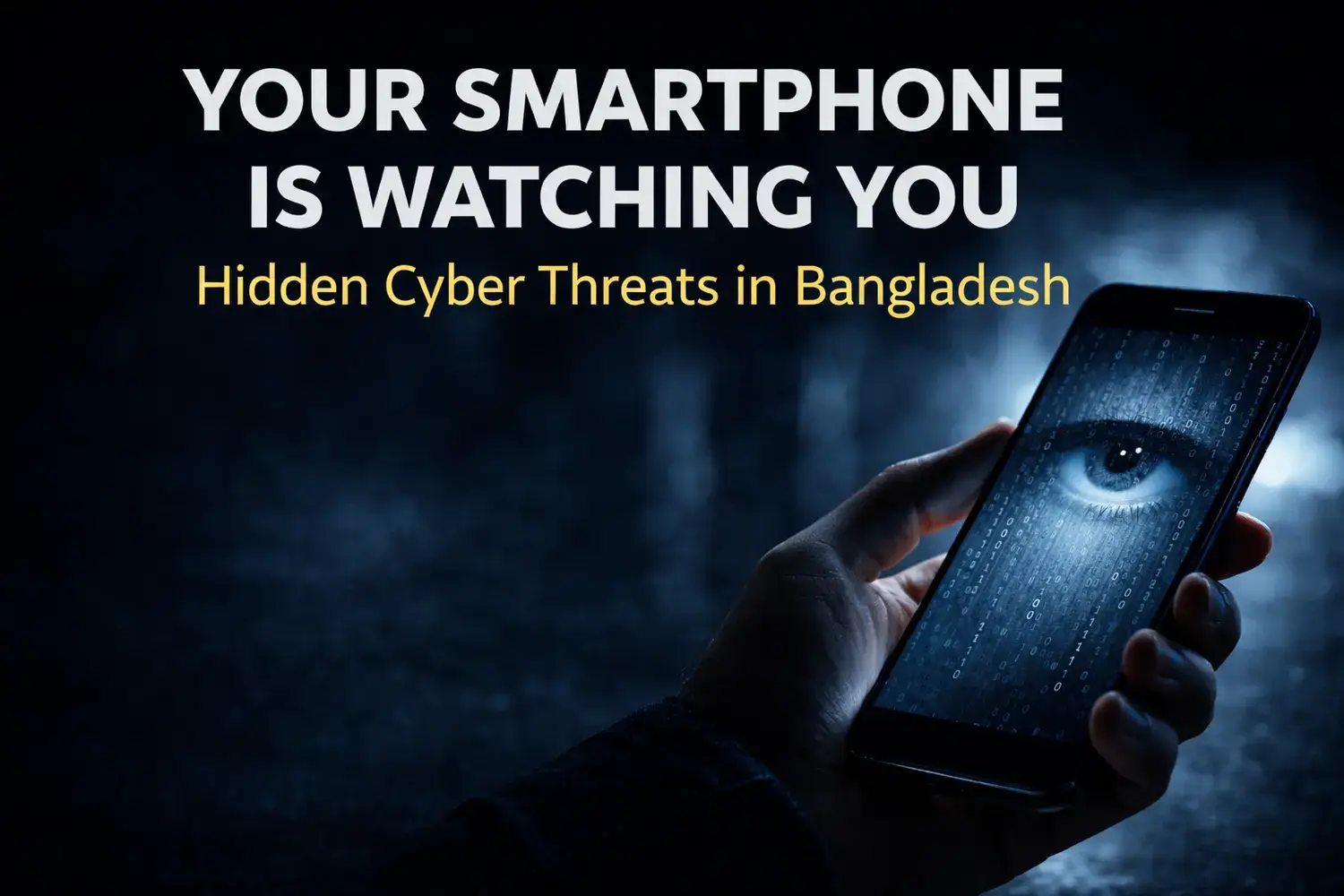
🧩 A Device You Trust — Or a Silent Observer?
Smartphones have become essential to modern life. From mobile banking and private conversations to business communication and personal memories—everything is now stored in a device that rarely leaves your hand.
But beneath this convenience lies an uncomfortable truth:
your smartphone may be watching you.
In Bangladesh, where smartphone usage has surged rapidly, cyber threats are evolving just as fast. Yet awareness remains dangerously low. Most users are unaware of how their data is being collected, monitored, and potentially exploited.
This is not speculation—it is the new digital reality.
📊 Bangladesh’s Smartphone Boom — And Its Hidden Risks
With over 120 million internet users, the majority accessing the web via smartphones, Bangladesh has entered a mobile-first digital era.
However, this rapid growth has created critical vulnerabilities:
- Users install apps without checking permissions
- Public Wi-Fi is widely used but often unsecured
- Low-cost devices lack regular security updates
- Awareness of cyber threats remains minimal
This combination has turned smartphones into easy targets for cybercriminals.
🔍 How Your Smartphone Is Watching You
📱 1. App Permissions: The Silent Access Point
Most apps request access to sensitive features like camera, microphone, location, and contacts.
But here’s the issue:
Many apps request more access than necessary.
Once granted, they can:
- Track your real-time location
- Record audio in the background
- Access personal contacts and messages
- Monitor app usage behavior
This data is often transmitted to external servers and used for profiling—or worse, exploitation.
🦠 2. Malware & Spyware: Invisible Threats
In Bangladesh, mobile malware is spreading through:
- Fake apps
- Modified APK files
- Links shared via social media
Once installed, spyware can:
- Capture passwords
- Take screenshots
- Access financial apps
- Activate your camera or microphone
The most alarming part?
You may never realize your phone is compromised.
🎣 3. Phishing: The Most Widespread Attack
Phishing attacks are now one of the biggest cyber risks in Bangladesh.
Common examples include:
- Fake bKash or Nagad verification messages
- Bank alerts with malicious links
- Job offers requiring login credentials
These scams trick users into entering sensitive information on fake websites.
Once stolen, attackers can:
- Access bank accounts
- Steal money
- Take control of digital identities
📶 4. Public Wi-Fi: A Hidden Trap
Free Wi-Fi networks are convenient—but often unsafe.
Hackers can create fake networks that look legitimate. Once connected:
- Your data can be intercepted
- Login credentials can be stolen
- Sensitive activity can be monitored
This type of attack is known as a Man-in-the-Middle (MITM) attack.
📡 5. Data Tracking & Behavioral Profiling
Even legitimate apps collect large amounts of user data, including:
- Search history
- Location patterns
- App usage behavior
This data is used for targeted advertising—but can also be shared with third parties.
Over time, this creates a digital profile of your life.
⚠️ Why Bangladesh Is More Vulnerable
Several factors increase cyber risk in Bangladesh:
❌ Low Awareness
Many users are unfamiliar with basic digital security practices.
❌ Weak Data Protection
Regulatory frameworks are still developing compared to global standards.
❌ Unsafe App Installation
Apps are often downloaded from unofficial sources.
❌ Rapid Digital Finance Growth
Mobile banking is expanding faster than user security awareness.
🚨 Real-World Consequences
These threats have real impacts:
- Financial fraud and account hacking
- Identity theft
- Personal data leaks
- Blackmail using private content
- Corporate security breaches
For professionals, a compromised phone can expose entire organizational systems.
🧪 Signs Your Smartphone May Be Compromised
Watch for these warning signs:
- Rapid battery drain
- Overheating without usage
- Unknown apps installed
- High data usage
- Unusual pop-ups
- Camera or microphone activating unexpectedly
🛡️ How to Protect Yourself
✅ Control App Permissions
Only allow what is necessary
✅ Use Trusted App Stores
Avoid third-party APK downloads
✅ Update Your Device
Install security updates regularly
✅ Enable Two-Factor Authentication
Add an extra layer of protection
✅ Avoid Public Wi-Fi for Sensitive Tasks
Use mobile data or VPN
✅ Stay Alert to Phishing
Never click suspicious links
🌍 Global Perspective: A Growing Surveillance Era
This is not just a Bangladesh issue.
Globally:
- Tech companies collect user data
- Governments expand surveillance capabilities
- Cybercriminals exploit vulnerabilities
Bangladesh is part of this ecosystem—but with fewer protections.
⚖️ Privacy vs Convenience: The Digital Trade-Off
Smartphones offer unmatched convenience—but at a cost.
That cost is your data.
Most users are not consciously choosing this trade-off. It happens silently, in the background.
🔮 The Future: More Connected, More Exposed
With the rise of AI, IoT, and smart infrastructure, data collection will only increase.
Your smartphone will become part of a larger system that:
- Tracks
- Learns
- Predicts
The risks will evolve—and so must awareness.
🧭 Conclusion: Awareness Is Your First Defense
Your smartphone is not just a tool—it is a gateway to your digital life.
In Bangladesh, where digital adoption is accelerating, cybersecurity awareness is no longer optional—it is essential.
Because the real question is not:
“Is your smartphone watching you?”
But:
“Do you know who is watching through it?”
Read in Bangla:
Prefer reading in Bangla? We’ve published a localized version of this analysis with practical insights for Bangladeshi users.