



A Tech Workforce the World Relies On—But Rarely Recognizes
Every day, software is written, servers are maintained, websites are secured, and digital products are shipped with the quiet involvement of Bangladeshi IT professionals. From freelance marketplaces to remote enterprise teams, Bangladeshi developers, engineers, and analysts have become embedded in the global digital economy.
Yet outside these workflows, Bangladesh is rarely mentioned as a serious technology hub.
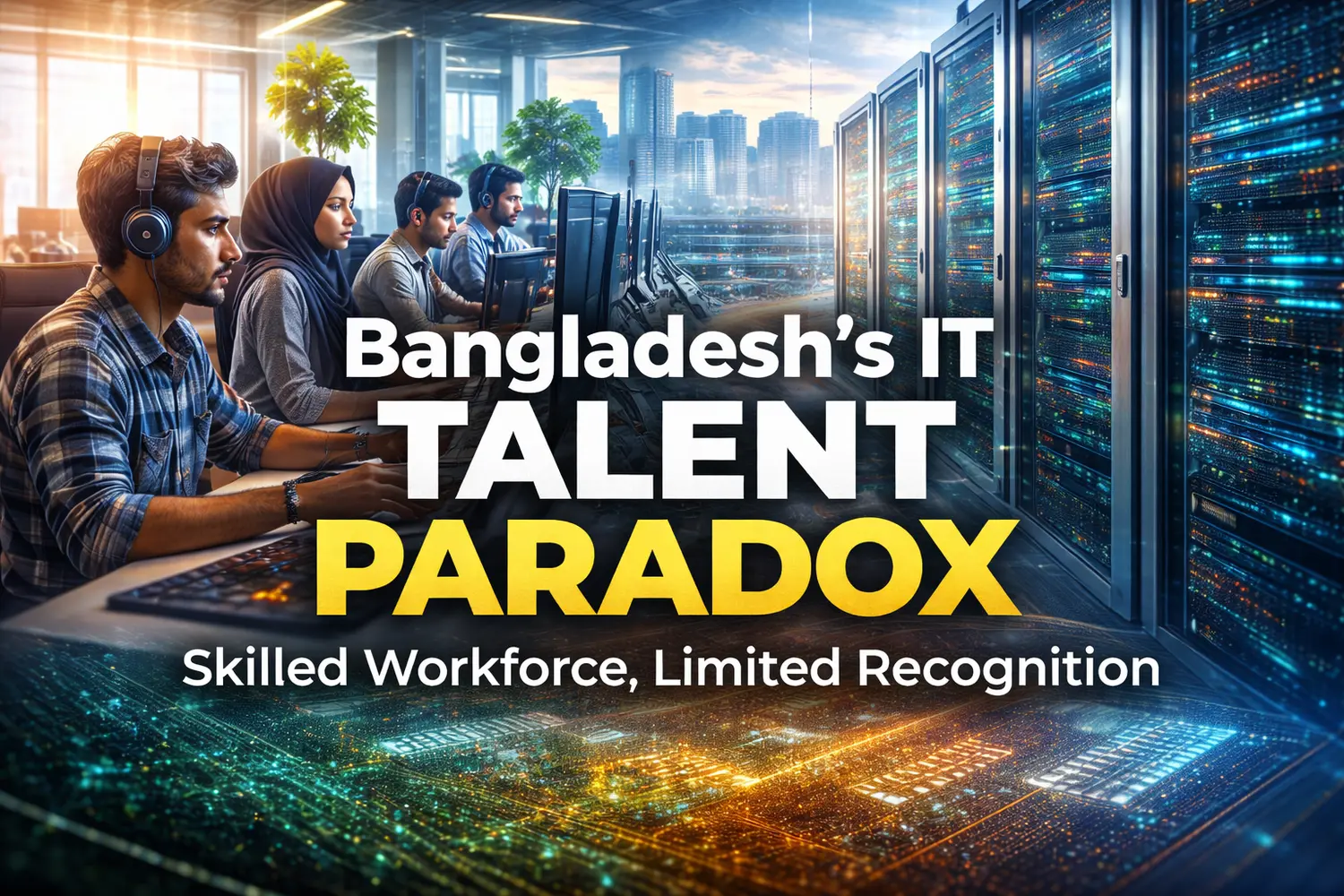
This contradiction defines Bangladesh’s IT talent paradox. The country supplies skills to the world, but remains undervalued as a technology ecosystem. Its professionals are visible; its national tech identity is not. Bangladesh is often perceived as a low-cost outsourcing destination rather than a source of innovation, reliability, or strategic capability.
This article explains why that gap exists, how it formed, and what structural changes are required for Bangladesh to move from being a hidden contributor to a recognized digital player.
The Emergence of a Large IT Workforce
Bangladesh’s IT workforce did not grow through a single policy success or government initiative. It emerged organically, shaped by demographic pressure, economic necessity, and global opportunity.
Several forces contributed to this growth:
-
Expansion of computer science and engineering programs
-
Affordable internet access and widespread smartphone adoption
-
Global demand for remote digital labor
-
Self-learning culture driven by online resources
Today, Bangladeshi professionals work across:
-
Software and web development
-
Network and system administration
-
Cloud infrastructure and DevOps
-
Cybersecurity, data, and analytics
In terms of numbers, Bangladesh has succeeded. In terms of ecosystem depth and recognition, it has not yet crossed the threshold.
Freelancing: A Breakthrough That Became a Ceiling
Bangladesh is consistently ranked among the world’s leading freelancing countries. For individuals, freelancing created access to global income without migration, capital, or institutional backing.
This success, however, produced unintended structural consequences.
Freelancing:
-
Rewards speed and price competitiveness
-
Prioritizes individual reputation over institutional learning
-
Limits exposure to enterprise-scale systems
-
Does not build national or corporate brands
As a result, Bangladesh became globally visible as a source of labor, not as a source of technology leadership. Skills accumulated—but mostly in isolation.
Why Bangladesh Is Still Framed as “Low-Cost Tech”
Despite measurable improvements in technical capability, Bangladesh remains locked into a cost-driven identity. Several factors reinforce this perception.
Price-Based Market Entry
Bangladesh entered global IT markets by competing on affordability. Over time, price became its defining signal—overriding skill, specialization, or quality.
Service-Dominated Output
Most Bangladeshi IT work is service-based. Globally recognized products, platforms, or proprietary technologies remain rare.
Limited Enterprise Trust Signals
Large clients look for certifications, compliance histories, and repeat delivery at scale. Bangladesh lacks sufficient institutional proof points.
Once established, these perceptions become self-reinforcing.
Education Produces Graduates—Not Always Enterprise Readiness
Each year, Bangladesh adds a large new cohort of computer science and technology graduates to its workforce—yet the transition from academic training to enterprise-level readiness remains uneven. The challenge lies not in quantity, but in alignment.
Common gaps include:
-
Curricula lagging behind industry needs
-
Limited hands-on exposure to enterprise systems
-
Weak emphasis on documentation, process, and compliance
Graduates often possess strong foundational skills but lack familiarity with global enterprise expectations. Companies must invest heavily in retraining—slowing organizational maturity.
Infrastructure: Progress Without Uniform Reliability
Bangladesh has invested heavily in digital infrastructure:
-
Data centers and cloud adoption
-
Nationwide fiber connectivity
-
Expanded mobile broadband
However, global technology operations depend on consistency, not averages.
Persistent challenges include:
-
Power redundancy outside major urban hubs
-
Variable broadband quality
-
Limited disaster recovery readiness
For international clients, infrastructure risk translates directly into trust deficits.
The Missing Middle of the Tech Ecosystem
One of the most critical structural gaps in Bangladesh’s IT sector is the absence of strong mid-sized technology firms.
The ecosystem currently consists of:
-
A large number of individuals
-
A small number of large firms
-
Very few globally visible mid-tier companies
This “missing middle” restricts:
-
Leadership development
-
Complex project execution
-
Knowledge transfer
-
Brand formation
Countries that succeed technologically rely heavily on this middle layer. Bangladesh has yet to build it at scale.
Cybersecurity and Compliance: The Trust Equation
In global IT markets, talent alone is insufficient. Trust is built through systems.
Enterprise clients increasingly demand:
-
Data protection frameworks
-
Secure development practices
-
Incident response readiness
-
Regulatory compliance
Bangladesh has capable cybersecurity professionals, but institutional adoption of standards remains inconsistent. Skills exist—but trust frameworks are uneven.
Global Platforms and Perception Lock-In
Global freelancing platforms and outsourcing marketplaces categorize countries early—and rarely revise those labels.
Bangladesh entered these platforms as a low-cost option. Algorithms, filters, and client expectations reinforced that image. Even highly skilled professionals face skepticism tied to geography.
This creates perception lock-in:
-
Higher-value proposals are filtered out
-
Complex projects are routed elsewhere
-
Price becomes the default differentiator
Breaking this cycle requires collective repositioning, not individual excellence alone.
Brain Drain Without Migration
Bangladesh experiences a subtle form of brain drain. Many senior professionals work remotely for foreign firms while remaining physically in the country.
While this benefits individuals, it weakens ecosystem development:
-
Knowledge remains locked in individual contracts
-
Local firms fail to absorb advanced practices
-
Institutional learning does not compound
Successful tech nations convert individual expertise into organizational memory. Bangladesh struggles to do so.
Product Innovation: The Missing Reputation Multiplier
Global recognition in technology is rarely built on services alone. It is built on products.
Products:
-
Signal innovation and ambition
-
Attract investment
-
Create brand memory
-
Anchor ecosystems
Bangladesh lacks internationally visible tech products. Without them, talent remains invisible at the ecosystem level.
Why Government Branding Alone Falls Short
Government-led digital branding initiatives promote Bangladesh as IT-friendly. While helpful, branding cannot substitute for structural credibility.
Global decision-makers look for:
-
Recognizable companies
-
Proven case studies
-
Compliance histories
-
Peer validation
Recognition follows repetition—not slogans.
The Long-Term Risk of Staying Undervalued
If Bangladesh remains locked into low-cost positioning, long-term risks include:
-
Wage stagnation despite skill growth
-
Talent frustration and burnout
-
Increased competition from cheaper markets
-
Missed opportunities in the knowledge economy
Moving up the value chain is no longer optional—it is strategic necessity.
From Speed to Strategy
Bangladesh’s IT sector grew quickly because it adapted fast. The next phase requires a different mindset.
This means:
-
Prioritizing value over volume
-
Investing in internal systems
-
Building firms, not just careers
-
Accepting slower short-term growth for long-term credibility
Speed built the foundation. Strategy must define the future.
Conclusion: Recognition Follows Structure, Not Talent Alone
Bangladesh has already crossed the hardest threshold: producing capable IT talent at scale.
The remaining challenge is structural—turning dispersed skill into trusted systems, respected firms, and recognizable products. Until that happens, Bangladesh’s IT sector will remain paradoxical: technically strong, globally underestimated.
When structure catches up with talent, recognition will follow—not because it is requested, but because it becomes unavoidable.